

What Is the Best Base for a Garden Room? Concrete, Screw Pile & More Explained
The four main base types, their costs, pros and cons, and which one My Retreat includes as standard.
The base is the most important part of any garden room build. Get it right and the structure stays level, dry and stable for decades. Get it wrong and you will be dealing with uneven floors, condensation and settlement cracks within a few years. This guide covers every base option, what each one costs, and which one is right for your garden.
Every My Retreat price includes concrete pile foundations as standard. The piles go around 600mm into the ground and give a solid, cost-effective base for the vast majority of Surrey gardens.
After the site visit, we may recommend ground screws where the ground suits them, for example on a slope or near trees, where they avoid severing feeding roots. They go approximately 1.2 metres into the ground and stay very stable as the ground moves over time.
A concrete pad or raft is worth considering for heavier uses, such as a gym with substantial equipment. It depends on your ground and how you plan to use the room.
I would avoid plastic grid systems or similar lightweight foundations, as ground movement over time can affect the stability and levelling of the garden room.
Why the Base Matters More Than People Expect
Most customers focus on the design, the cladding and the glazing. The base tends to be an afterthought. This is a mistake. A garden room sits in a garden, exposed to moisture, frost and ground movement year-round. Without a properly engineered base, even the best-built room will move, dip and deteriorate over time.
The base also determines whether your room feels solid underfoot, whether moisture gets in from below, and whether the structure stays level as the ground shifts through the seasons. It is the foundation of everything else, and it deserves the same attention as the rest of the build.
Not sure which base is right for your garden?
Ask Kieron directly →The Four Main Base Options
Here is a straightforward comparison before the detailed breakdown below.
| Base type | Approx. cost | Best for | Rating |
|---|---|---|---|
| Ground screws | £800 – £2,800 | Sloped or difficult ground, trees nearby, faster install | Recommended where the ground suits |
| Concrete piles | £500 – £1,200 | The vast majority of gardens, level or gently sloping ground | Included as standard |
| Concrete raft | £1,450 – £5,000+ | Heavy equipment, large builds, building regs | Situational |
| Plastic grid / pads | £200 – £600 | Lighter outbuildings such as sheds only, not garden rooms | Not recommended |
Costs above are indicative for garden rooms from 9m² up to 30m² and exclude VAT. Prices were correct at the time of publishing but will vary depending on ground type, waste removal requirements, access and other site-specific factors. They are intended as a guide only. We assess foundations during the free site visit and confirm the actual cost before you commit to anything.
Option 1: Ground Screws
What it is
Ground screws are large steel helical piles screwed directly into the ground using a mechanical driver, with no excavation required. They are installed approximately 1.2 metres into the ground. A steel subframe sits on top of the screws, which are individually adjustable to create a perfectly level base regardless of the slope of the ground beneath.
Why it works well
Ground screws are fast to install and cause minimal disruption to the garden. Where there are trees nearby they avoid severing feeding roots, which can be a real issue with more invasive groundwork. Because they go 1.2 metres into the ground, the structure remains very secure even if the ground naturally shifts over time. They are also fully removable if the room ever needs to be relocated.
Best suited to
Sloped or uneven ground, restricted access sites, gardens with established trees, and anywhere minimal disruption is important. Also a good option where a customer may want to move the room in the future.
Limitations
Not suitable where there are significant underground obstructions close to the surface, such as old tree stumps, buried rubble or hard rock, that stop the screw reaching its full depth. A ground investigation may be needed on some sites before confirming suitability.
Option 2: Concrete Pile Foundations
What it is
Concrete piles are cylindrical columns of concrete poured into bored holes in the ground, typically 200 to 300mm in diameter and around 600mm deep. A series of piles support the steel frame floor system of the garden room above, with adjustable fixings to ensure a perfectly level base even on uneven ground.
When it works well
Concrete piles are our standard foundation: cost-effective, reliable and suitable for the vast majority of gardens. They require minimal excavation, cause little disruption to the garden, and provide a solid, permanent base. The steel frame floor system we install on top is one of the things that distinguishes a My Retreat garden room from cheaper alternatives.
Best suited to
Level and gently sloping ground. Suitable for all room sizes up to the point where building regulations apply (over 30m²).
Limitations
Not the best option for significantly sloped ground or sites with very poor ground conditions. Your site visit will determine whether piles are appropriate or whether ground screws or a raft are a better fit.
Want to know which base is right for your specific garden?
Start with a 3D design →Option 3: Concrete Raft
What it is
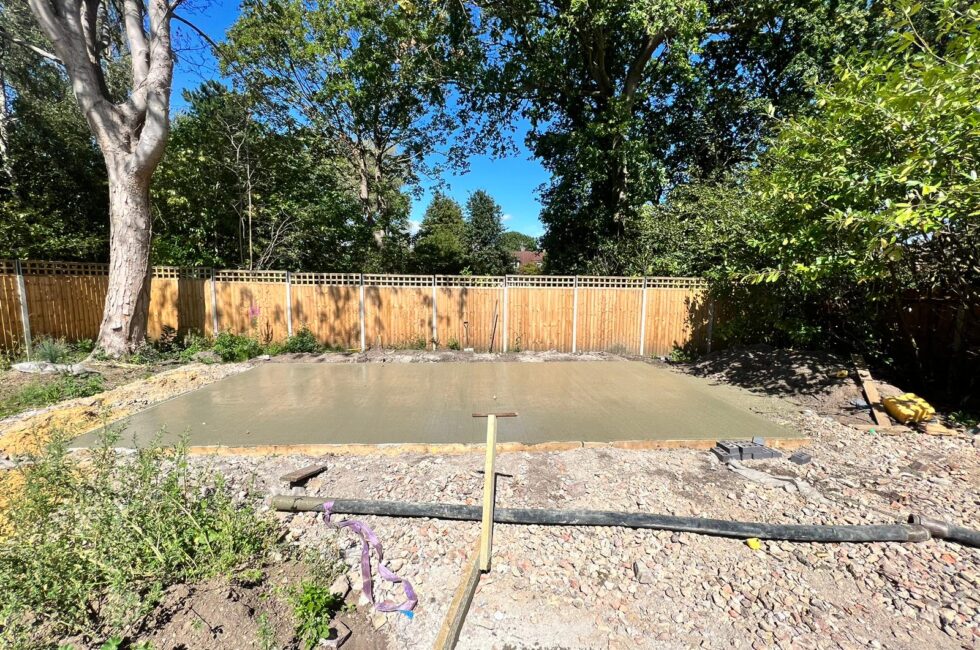
A concrete raft is a full reinforced concrete slab poured across the entire footprint of the room, typically 150mm thick with steel reinforcement, sitting on a compacted hardcore sub-base. It is the most substantial and most expensive base option.
When it is the right choice
A concrete raft is the best option for a garden room gym with very heavy equipment, particularly if you are installing a full weights rack or heavy machines where point loads on a timber floor would be a concern. It is also required for any build over 30m², where building regulations apply and the foundation must be designed specifically to suit the soil type.
Best suited to
Gym builds with heavy equipment, rooms over 30m², sites where building regulations apply, or customers who want the most permanent and solid base possible regardless of use.
Limitations
Higher cost, longer installation time, and significantly more disruption to the garden during groundworks. Concrete is also less environmentally friendly than the alternatives. Not necessary for the majority of standard garden room builds.
Option 4: Plastic Grid Systems and Concrete Pads
What it is
Plastic grid systems use interlocking recycled plastic panels laid on compacted gravel to create a permeable base. Concrete pads are individual precast concrete slabs placed at key points under the structure rather than a continuous foundation.
Where it is appropriate
These systems can work for small, lightweight structures such as a basic summer house or log cabin that will not be used year-round. They are low cost and quick to install.
Why we do not use them for garden rooms
A fully insulated, year-round garden room is a permanent structure with significant weight. Plastic grids and individual pads do not provide the rigidity or permanence needed for this type of build. They are more susceptible to movement, moisture ingress and subsidence over time. My Retreat does not use these systems for our garden room builds.
Watch: Garden Room Bases Explained
A short walkthrough of the main garden room base options and what to look out for on your own site.
What My Retreat Uses and Why
Concrete piles are included as standard in every My Retreat price. After the free site visit, we may recommend ground screws where the ground suits them, installed by our specialist partner No More Digging. They are fast, clean, tree-friendly and extremely stable on slopes and difficult ground.
We assess ground conditions during the site visit and confirm the foundation before you commit. If your site needs something other than the standard piles, we tell you the difference in cost up front.
For gym builds with very heavy equipment, large builds requiring building regulations approval, or complex groundworks including reinforced concrete slabs, we work with our trusted groundworks partner Country Landscapes & Design, who have extensive experience across Surrey and the Home Counties.
Frequently Asked Questions
Does a garden room need a concrete base?
How much does a garden room base cost?
What is the cheapest base for a garden room?
What is the best base for a garden room on a slope?
Can I use paving slabs as a base for a garden room?
How deep do garden room foundations need to be?
Do garden room foundations need building regulations approval?
Are ground screws as good as concrete foundations for a garden room?
Helpful Pages
- Design your own garden room and get a price within one working day
- How much does a garden room cost? Our 2026 price guide
- Garden room planning permission in Surrey
- Garden room insulation: what is the best option?
- Best cladding for a garden room
- How we build your garden room, step by step
- Garden room gym builds in Surrey
- Garden office builds in Surrey
- Frequently asked questions
Ready to Find the Right Base for Your Garden Room?
We assess your ground conditions during a free site visit and confirm the right foundation before agreeing any price. No surprises, no hidden extras.